Denton & Denton County, Texas
Denton Foundation Repair, From Brand-New Slabs to 1920s Pier Homes
Denton foundation repair questions come from two very different kinds of house. Nearly half the city's homes went up in 2000 or later, mostly on concrete slabs, while the streets near the square still hold frame houses on piers from before the Depression. Both sit on ground that swells when wet and shrinks when dry. Here is what moves them, what the city requires, and what published prices look like.
Most foundation repair in Denton means piers under a settled slab or new supports under a raised floor. Fixr (2026) puts a typical job at $2,200–$8,200, and HomeGuide (2025) puts pier and beam repair at $1,500–$15,000. Every Denton foundation repair needs a permit and a sealed engineer's letter.
Why foundation repair in Denton comes up so often
Two things work against a Denton foundation. The first is the soil. Sanger clay, the most widespread soil in Denton County, has its official reference site in a field 8 miles south of town on I-35W, and the federal soil survey records gaps of 1 to 3 inches opening in it, deeper than 20 inches, during dry spells (USDA NRCS). Of the county's rated land, only about 1% counts as not limited for a house on a concrete slab, and high shrink-swell is the reason cited on most of it.
The second is the rain, which arrives in lurches. Denton County got 26.27 inches in 2014 and then 63.62 inches in 2015, the wettest year in a record that starts in 1895. Its driest year, 2005, brought just 18.10 inches (NOAA NCEI). Ground that dries hard for a few years and then soaks for one does not move evenly under a house, and the uneven part is what cracks brick.
What the City of Denton requires before a foundation repair
The city's rule is short: all foundation repairs require a permit. The application must include a foundation repair letter and plan signed and sealed by a Texas registered engineer, and before the final inspection the engineer's final sealed report has to be uploaded to the city's eTRAKiT portal (City of Denton Development Services).
That means two engineer documents bracket every job: one saying what will be done, and one saying it was done. Ask any company bidding on your house whose engineer seals the plan, who pulls the permit, and whether both are in the price. Contractors working in Denton must also hold a city registration; for a general contractor it costs $73 a year and asks for photo ID and a list of authorized people, so it is a record, not a skills test.
Three repairs Denton houses need most
- Foundation piers compared: pressed, steel or drilledHow each pier type reaches firm ground, which suits Denton's deep clay and sandy east side, and who picks.
- Post-tension slabs in newer Denton homesCables in the concrete, what the builder's paperwork shows, the Texas notice law for defects, and how repairs differ.
- House leveling for older raised floorsPier and beam houses near the square and the campuses: shims, sunken pads, rotted beams and rentals.
- What foundation repair costs in DentonPublished national ranges for piers, leveling, engineer letters, slab leaks and patching, each with its guide and year.
Before you hire anyone
- Denton's ground: clay to the west, sand to the eastSoils named for Denton County places, the three land regions under the county, and a rainfall record that swings hard.
- Foundation signs, room by roomGarage, front door, bedroom corners, kitchen, yard and water bill: what each sign usually means.
- Slab leak or foundation? Plumbing tests firstThe meter check, pressure and drain tests, Denton's plumbing permit rule, and why the leak gets fixed before the lift.
Newer subdivision or pre-war bungalow: which repair fits your house?
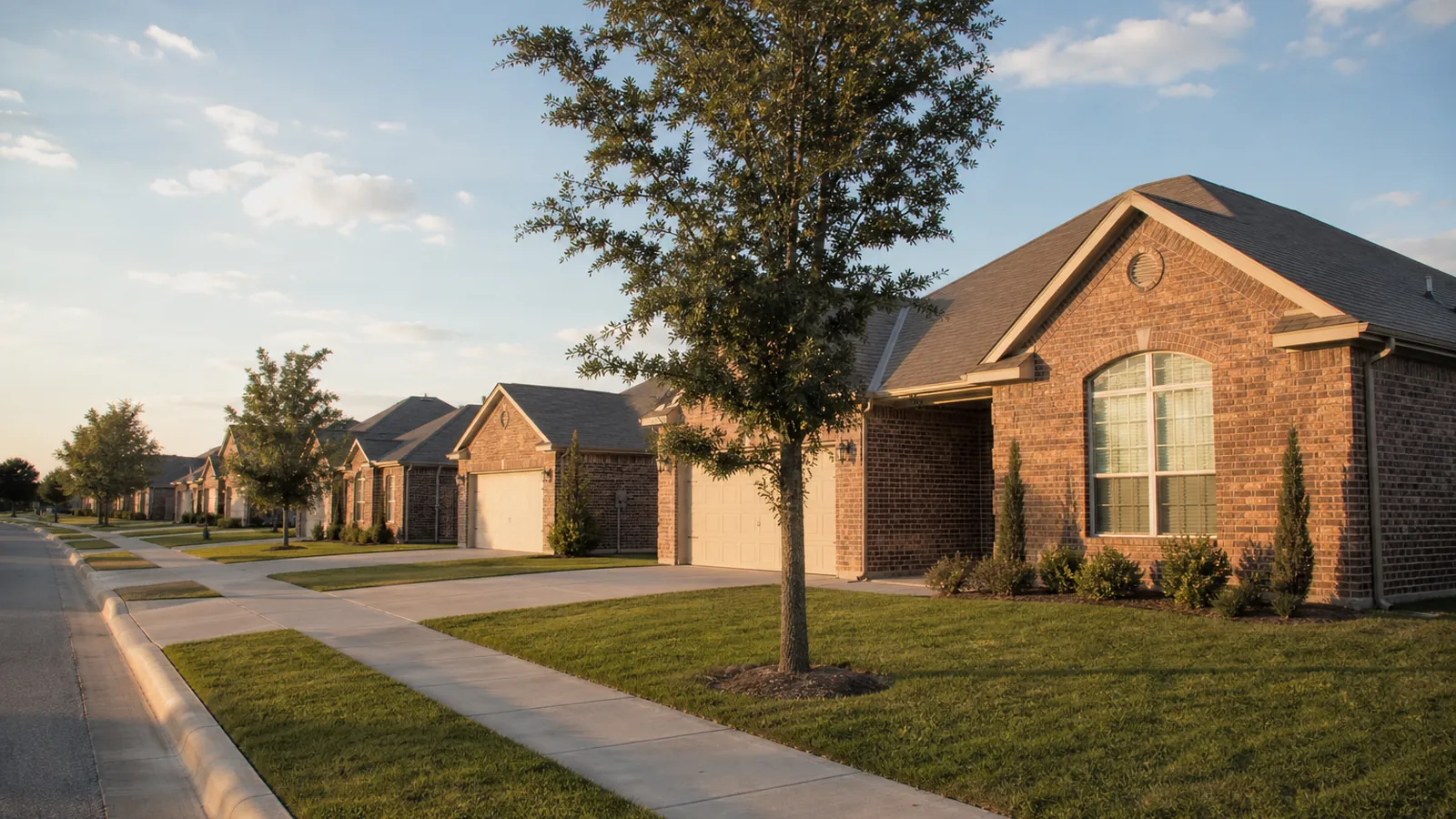
About 47% of Denton's 60,531 homes were built in 2000 or later, and the median home dates to 1997 (U.S. Census ACS 2020–2024). Houses of that age in North Texas are typically built on concrete slabs, and post-tensioned slabs, with steel cables pulled tight inside the concrete, are common in home building (Post-Tensioning Institute). Trouble usually shows first as cracks in the garage floor, brick or drywall. See post-tension slab repair in newer Denton homes.
Older Denton is a different house. The National Register nomination for the West Denton Residential Historic District, just northeast of the University of North Texas, counts 332 homes from 1890 to 1957 and says most have pier and beam foundations skirted with brick, concrete or stone (Texas Historical Commission). Their floors sag and roll rather than crack. See house leveling for raised floors.
Whichever you have, the piers themselves come in a few types, compared on the foundation piers page.
Renting, owning and the campus neighborhoods
With two universities in town, exactly half of Denton's 56,664 occupied homes are rented (U.S. Census ACS). Tenants who spot a growing crack should tell the owner in writing, with a date and photo; the owner arranges the repair and the permit. Owners should keep each sealed engineer's report, because the next buyer will ask.
Who reads a request sent from this site
This site explains Denton's ground, rules and published prices; it never inspects, engineers or repairs. Your form goes to one independent foundation specialist working in and around Denton, who pays this site for each referral. Asking is at no cost, and other bids stay open to you.
Questions homeowners ask
Is one side of Denton more prone to foundation movement?
The west side sits on more clay. Federal soil maps show Ponder loam and Sanger clay west of downtown, while the east side runs into sandy East Cross Timbers soils such as Birome and Callisburg (USDA NRCS). Sandy is not safe, though: Birome turns to red clay about 9 inches down, so east-side slabs still move.
Can a house built in the last ten years need foundation repair?
Yes, although many early cracks are shrinkage, not movement. A quarter of Denton's homes were built in 2010 or later (U.S. Census ACS). Hairline cracks in a garage slab or drywall are common in the first years. A crack that widens, a door that starts binding, or brick separating at a corner deserves an engineer's look and a note to the builder in writing.
What does the city's sealed engineer letter do for me?
It puts a licensed engineer's name on the repair plan and on the finished work. Denton requires a sealed letter and plan with the permit and a sealed final report before the final inspection. Keep both: they show a buyer or an insurer what was done, and you can look up the engineer on the state board's public roster.
Sources
- USDA NRCS Official Series Description: Sanger series
- USDA NRCS Web Soil Survey (Denton County, Texas soil survey)
- NOAA NCEI Climate at a Glance: Denton County, Texas precipitation, 1895-2025
- U.S. Census Bureau, ACS 2020-2024: year structure built, Denton city
- National Register nomination: West Denton Residential Historic District (Texas Historical Commission)
Tell us about the house
A sentence or two does it: the year the house was built if you know it, and what changed. A garage floor crack that grew, a back door that drags in August, a living room floor that dips toward the middle. One independent foundation specialist who works around Denton reads it and gets in touch.